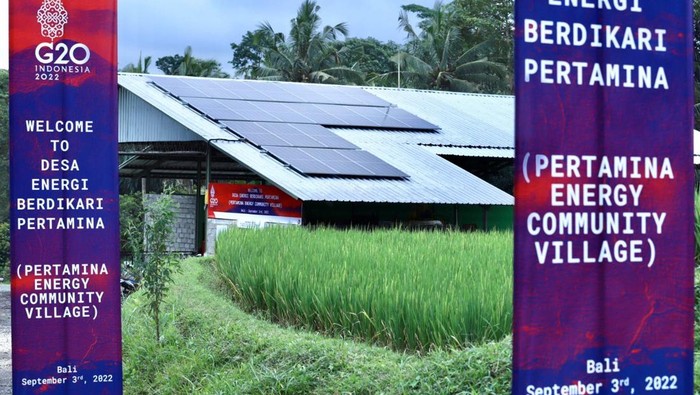
Solar panels stretches between the green paddy rice landscape in Keliki village, Gianyar Regency, Bali. This unusual landscape in a village known for its natural beauty is a pilot project for the EBT-based Self-Sufficient Village Energy (DEB) started by Pertamina. The appearance of such system in Keliki village stimulates the economy of the villagers without concerns of running out of power.
Solar panels in Keliki village are situated in 8 spots with the capacity of 28 kWp to power 1028 families in the village. One of the solar panels is used to operate a recycling center and 7 others are installed in “subaks” (irrigation system in Bali) as a source of power for water pumps to be used for irrigation and other villagers needs. The seven subaks are Subak Tain Kambing, Subak Uma Desa Sebali, Subak Uma Desa Keliki, Subak Jungut, Subak Umelikode, Subak Bangkiangsidem, and Subak Lauh Batu.
Wayah Sumada, the director of the BUMBDes Keliki remembers well on how his village is chosen as the village for the DEB Pertamina program. Starting from the concerns and worries of the villagers who has yet to enjoy the benefits of tourism compared to other areas, they started to improve the cleanliness of this village so that it may be visited by tourists. Wayan realizes that without improvement, the economy of the village will have difficulties going up.
“At the start of DEB, we started with concerns, worries, and fears on why despite our status of being an assistant neighbor status for Ubud City, a tourism city, we were yet to receive anything of such benefits from this status. So then we started improving the village in its cleanliness and village restructuring. However, this was deemed not enough because we received numerous complaints about the environmental cleanliness of the village,” said Wayan Sumada.
Keliki Village’s transition to self-reliance continued in 2019 when the establishment of BUMDes Yowana Bakti Keliki which manages waste management units, savings and loans, village stalls, service bureaus, and village PAM. The plan, BUMDes Keliki also formed a tourism village unit. The first business unit managed by BUMDes Keliki was a waste management unit which was initially accompanied by the Bumi Sasmaya Ubud Foundation to create a waste treatment system, make village regulations, and educate the people of Keliki Village to sort waste.
“We are looking for solutions on how to manage the environment. So in 2019 we started to make BUMDes, waste processing business units, purely the BUMDes program by procuring 1 unit of garbage trucks to manage waste processing in Keliki Village with a waste transportation system,” said Wayan Sumada.
Initially, Keliki Village residents were educated to sort organic and inorganic waste and subscribe to waste transportation. Then, in 2022, TPS3R in Keliki Village will operate to process and recycle residents’ waste that has been sorted before being transported. TPS3R Keliki Village produces compost from organic waste, while non-organic waste is sorted in collaboration with waste banks. The electricity of TPS3R Keliki Village is supported by clean energy with solar panels from Pertamina which can reduce operational costs.
“With the help of solar panels from Pertamina, it really helps us in operations, in electricity costs,” Wayan said loudly.
TPS3R Keliki Village managed to turn the impression of a disgusting trash can into an exciting one. TPS3R Keliki Village is well arranged and comfortable and there is even a fishing pond that is routinely used as a fishing spot every week. The waste management unit of Keliki Village also absorbs a workforce of 11 people, thus providing economic impact for local residents.
Wayan Sumada also glanced at the management of tourism villages as a destination for tourists, especially foreign tourists, to boost the village economy. The tours offered by Keliki Village include TPS3R for education, fishing ponds, and cultural attractions so that many tourists are expected to be interested in visiting.
“For this reason, now we want to organize and manage Keliki Village tourism into a business for the village whose goal is to increase PAD (local original income). We moved last month to create a tourism village management structure,” Wayan said excitedly.
Solar panels in Keliki Village also play an important role as an energy source to drain water to residents’ rice fields. In addition to being an energy source to operate TPS3R, solar panels are also an energy source for water pumps in seven subak Keliki Villages. Keliki villagers who farm no longer need to carry water far to irrigate their land. In fact, clean water from Subak can also be consumed.
“Assisted by the procurement of solar panels in each subak, its function is to drive a water pumping machine to help irrigation of each subak. With the help of Pertamina, boreholes driven by engines with solar panels do not need to carry clean water. Clean water can also be used to drink in the fields, so just bring a place from home, “explained Wayan.
Keliki Village residents not only depend on income from farming, some of them become Micro, Small and Medium Enterprises (MSMEs) by utilizing materials from nature, such as banana fronds that are used as photo albums, ecoprints or fabric dyes from nature, and paintings. Wayan hopes that the energy transition in Keliki Village can also touch MSMEs.
“There are so many MSMEs, one of which is making photo albums, the material is from nature, banana frond leaves can be made into photo albums used as souvenir merchandise by guests, there are ecoprints of fabric dyes from nature, from leaves in Keliki Village, hand paintings we have in Keliki Village,” explained Wayan.
Wayan also hopes that Keliki Village’s waste processing unit, TPS3R can be independent because currently some operational costs still come from the village government and community dues. The results of waste processing from TPS3R are expected to be high-value products, so that they can be independent.
“If we can process non-organic waste into products that we can sell, maybe TPS3R will be operationally independent faster,” hoped Wayan.
Pertamina Boosts Energy Transition for the Economy of Citizens
Vice President of CSR &; SMEPP of PT Pertamina (Persero) Fajriyah Usman said, Pertamina’s DEB program began in 2019 starting from social mapping related to community needs for energy access for economic empowerment. The DEB program aims to encourage energy and economic independence of rural communities. In addition, DEB is also part of achieving net zero emissions (NZE) by 2060.
“The purpose of this program is to encourage energy independence and economic independence of the community. In addition, this program is also Pertamina’s concrete action to support the government’s efforts to achieve Net Zero Emission in 2060. In general, this program is in line with SDGs point 7 (Clean and Affordable Energy), point 8 (Decent Work and Economic Growth), and point 13 (Climate Change Handling),” Fajriyah told detikcom, Tuesday (10/10/2023).
Fajriyah continued, Pertamina’s DEB program also provides wider access to the community to access energy that has an impact on the economic activities of the Keliki Village community such as irrigation of rice fields to Micro, Small and Medium Enterprises (MSMEs). In total, he continued, there have been 63 Pertamina DEB programs that have resulted in benefits of 201,950 Wp of Solar Power Plant (PLTS) energy, 609,000 m3/year of biogas and methane gas energy, 8,000 watts of microhydro energy, 6,500 liters of biodiesel energy per year, and 16,500 Wp of Solar and Wind Power Plant hybrid energy.
“In addition to the energy impact, the Berdikari Energy Village program also has an impact on the economy for 3,571 Heads of Families (KK) and the impact of reducing carbon emissions by 611,119 tons of Co2eq per year,” explained Fajriyah.
The solar panels installed in Keliki Village were carried out by the GoGuerrilla team of the Ministry of Energy and Mineral Resources, the Society of Renewable Energy (SRE), and Udayana University students. The installation of solar PV in Keliki Village contributes to a reduction in carbon emissions of 37,750 kg C02 per year.
Energy Transition Is Key
Executive Director of ReforMiner Institute, Komaidi Notonegoro explained that energy transition is a move from the use of fossil energy to a more environmentally friendly one. Energy transition does not only have to be to new renewable energy (EBT), but can also transition to better energy quality, for example from the use of RON 88 to 95 fuel and so on.
“Not only fossil to EBT, it can be from fossil to environmentally friendly fossil, RON 88 to 95. Move to a higher quality one,” he said, Monday (16/10).
Is an energy transition necessary? Komaidi explained that it was seen from two sides, first about availability and second, the environment. Energy is needed continuously, while the resources available in nature such as petroleum are limited. This then encourages the existence of EBT sourced from solar, water, wind, geothermal, and others.
“The target is not to replace (fossil) energy, the target is to maintain a maximum temperature of several degrees, one of the instruments added by EBT. If you add a certain mix that has been maintained, it will not lose 100% (fossils), not necessarily EBT can be 100%. Second, it is still expensive, many factors cannot be replaced 100%,” he said.
EBT is the most suitable choice to be applied in several areas according to their respective energy potentials, such as in Keliki Village which utilizes solar power to be a source of electrical energy for TPS3R and water pumps. The use of NRE can also boost the economy of Keliki Village residents at the minimum possible cost.
“So, actually, when there is this transition, the goal is to meet the needs of the community, especially more fulfilled, if in remote areas, EBT is more compatible for areas that have not previously been reached by electricity,” he said.